At Home with Growing Old header image 1

Featured Posts

Rethink: Homes, Communities, Cities

by Susanne Stadler | November 28th, 2011 | Our Cities | Please Comment

Cities are human ecosystems – they pose challenges and opportunities. They are democratic.  As Jane Jacobs said they are about density, diversity and dynamism.  With the National Zoning Act of 1923  such diversity became illegal or highly regulated. Both the car and the elevator made the new monocultures possible and changed the city – what emerged were suburbia and shopping malls on one hand and financial “downtowns” on the other, socio-economic and use segregated zones. We are now trying hard to “fix” them since we have recognized that they are neither socially nor environmentally sustainable.

In my recent presentation at Build Boston 2011 sponsored by the formidable Institute for Human Centered Design (IHCD) I argued that socially sustainable design is the key for solving the challenges of an aging population. Socially sustainable design means designing for human needs. This implies that such solutions have to be integrated and interdisciplinary, specific and not generic. Solutions for suburbia look different from the one for a dense urban or a rural area. Spatial design and service design solutions have to be integrated. Whatever we call the places we live in – cities, communities, neighborhoods, gated communities, rural areas, suburbia – they are all have to answer to the needs for being “at home with growing old”.

When mixed-use developments are designed with social sustainability in mind they can offer such answers and produce wonderfully inventive and at times idiosyncratic results, both aesthetically and socially. We are not talking about the typical housing-retail mix that has brought us many miles of empty store fronts. We are talking about combining housing with civic functions such as the Mission Creek Project in San Francisco that houses affordable housing units and a branch of the San Francisco Public Library or looking at public transportation as a means of universal, equal accessibility for all ages as exemplified with the Vienna Public Library that is built over a major subway terminal.  Such adjacencies find different expressions or interpretations such as a senior housing project in Austria that shares the grounds with a pre-school or a nursing home that is is the result of a design competition and becomes the object of civic pride in a small town.

Let’s define principles for mixed-use developments not only for planners and developers but in a language that invites interdisciplinary collaborations and acknowledges equally innovative thinking in both spatial and social design; Alliance – Adaptability – Mobility.  Alliances in the early stages of developments, such as between planners and the transportation industry, between healthcare and housing have the potential to be truly sustainable. Adaptations of existing buildings for new functions or adaptations of buildings that lend themselves to be universally accessible harness the energy of an established environment. Creating mobility with the understanding that it is not only about going “into the world” but also about the world “coming to us” grants universal access in the true sense.

When we design for the human needs of an aging society we are designing for all of us, we design for inclusive and multi-generational, livelong and thus sustainable communities. The challenges of this demographic shift are a chance for all of us to rethink how we live in our homes, our communities, our cities.

Please Comment

Apartment ‘A’

by Susanne Stadler | November 15th, 2011 | Our Homes | Please Comment

Greetings all!

We have been super busy at my architecture firm, Stadler &. I do intend on debriefing you all on the previous At Home with Growing Old group meetings, but today I would like to debut a speculative project we have been working on in the office: Apartment A.

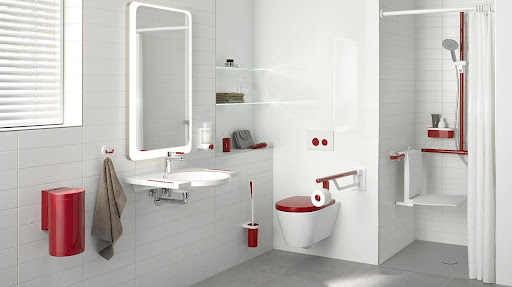
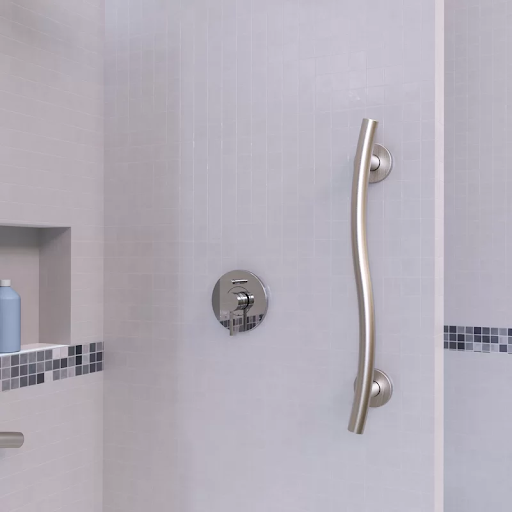
For nearly a year now, between projects, we have been working on a small “dream apartment” which would go against most conventional notions of what housing for older people ought to be. It would have lots of storage, but the storage would be organized in very specific ways. The space would be comfortable, but it would use the footprint of an ample but basic studio apartment, and it would feature plenty of built in furniture. We wanted to draw from different disciplines to achieve a kind of safety and comfort that would inspire delight. To that end, we used climbing grips instead of grab bars in the shower, and playground surface with a drain pan underneath instead of a regular shower pan in the bath.

We explored many iterations, and finally sent our most recent version to be rendered by the talented folks at Pirate Design. Voila! Apartment A is alive. Of course, we hope that we will captivate the imagination of developers to the end of building this, however, there are affordable principles behind Apartment A are transferable to new or rehab construction.

Soon, we will release more images of this project, so please check back here or at www.stadlerarch.com for updates. Meanwhile, I will be at the Build Boston 2011 conference, and I will be giving a presentation on the future of Mixed-Use Development and being “At Home With Growing Old” – please attend if you’re in the area!

Please Comment

AHWGO – A Salon on Aging

by Susanne Stadler | September 13th, 2011 | Our Selves | Please Comment

Musing    Exploring    Sharing   Learning    Connecting     Expanding One’s Thinking

These were some of the words a group of participants in AHWGO’s first strategy session used to describe what they thought the purpose of our get-togethers were.

Multidisciplinary    Interesting People     Stimulating Topics    Informal Structure    Nice Food

These were some of the words a group of participants in AHWGO’s first strategy session used to describe what they liked best about our get-togethers.

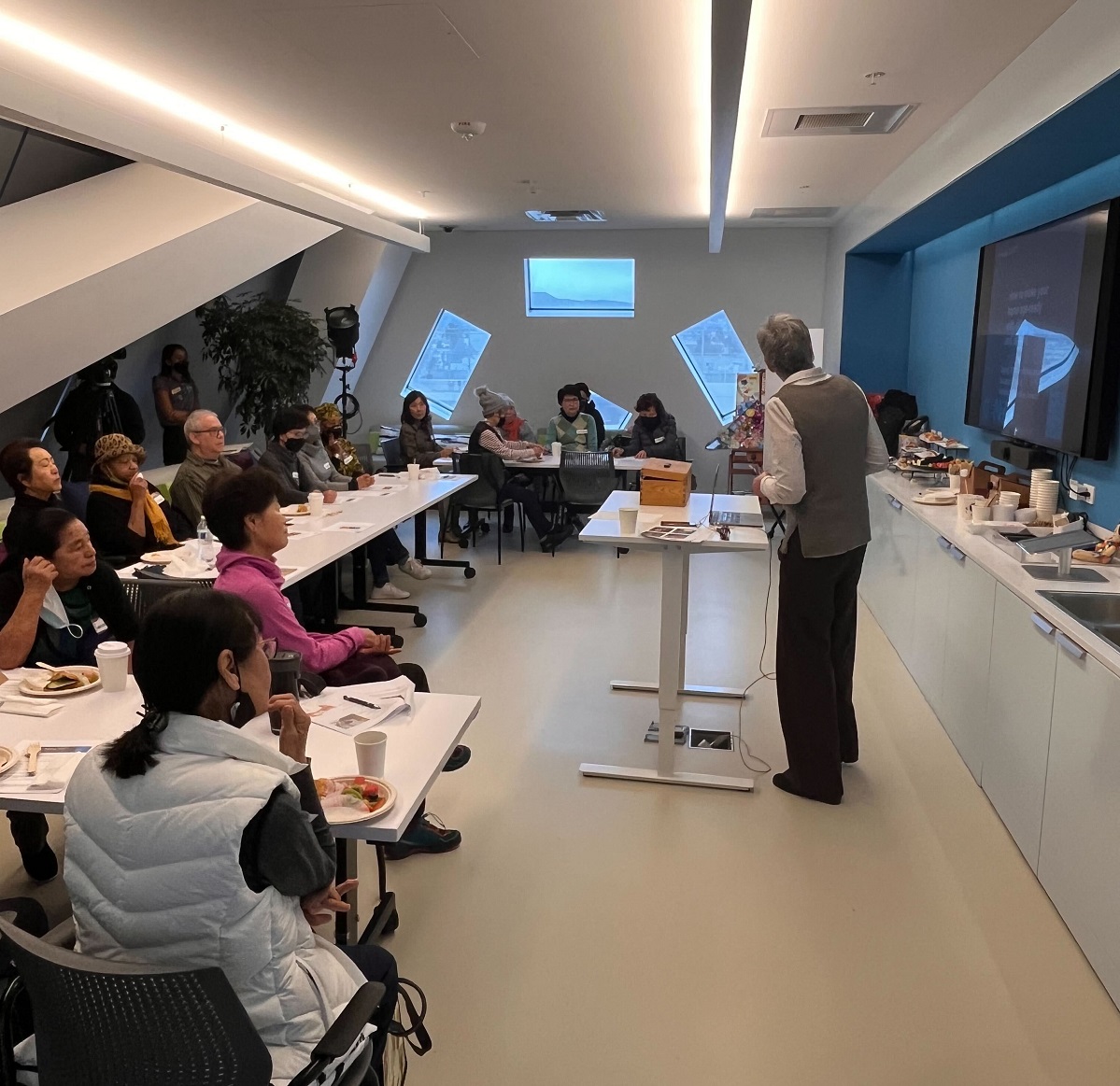
Two years after its inception, AHWGO called together a small advisory ‘council’ representative of our members, to explore what the ‘mood’ among them was and also to harness the knowledge, connections and energy of this group to attract speakers and muse about topics for future discussions.

It was rewarding to hear that AHWGO is filling a gap by giving people – outside their work and the commitments and agendas which come with it – the opportunity to explore together new ways of looking at the challenges of aging both from a societal and personal perspective in an informal setting, a ‘Salon’.

What we want to do more is to invite people from an even wider range of disciplines, such as ethicists, educators, policy makers, artists and more. We are not only affected  professionally by the tsunami of aging baby boomers but we also have the chance to learn more about the ‘job of aging’ for ourselves.

-So please feel inspired to bring colleagues and friends.

What we want to do better is to make it easier for people to come to our monthly Salon. We now we have more than 70 people on our mailing list. Coming to the’ Salon on Aging’ should be relaxing and not an obstacle course of parking and traffic so we are exploring new venues in both San Francisco and Berkeley that would give everybody easy access from BART.

-If you have an idea, please let us know.

What to look forward to. We have some wonderful evenings planned for you, with topics ranging from technology to spirituality.

-If you are interested in a specific topic, are willing to contribute to our discussions with your own presentation or if you know somebody who could contribute to an interesting discussion, please let us know.

We hope that alliances, collaborations and insights will continue to spring from our Salons. Here is to our third year and don’t forget – we would love you to contribute to our blog.

-Please read and comment www.athomewithgrowingold.com.

We thank our coach Nancy Friedman of Next Step Consulting who expertly facilitated our strategy session.

Please Comment